

Data snapshot - Bullying
BACKGROUND
Workplace bullying is repeated, and unreasonable behaviour directed towards a worker or a group of workers that creates a risk to health and safety.
Repeated behaviour refers to the persistent nature of the behaviour and can involve a range of behaviours over time.
Unreasonable behaviour means behaviour that a reasonable person, having considered the circumstances, would see as unreasonable, including behaviour that is victimising, humiliating, intimidating, or threatening.
The ACT’s WHS laws require persons conducting a business or undertaking (PCBUs) to minimize risks from hazards - including work-related harassment and/or workplace bullying – so far as is reasonably practicable. Examples of behaviour, whether intentional or unintentional, that may be workplace bullying if they are repeated, unreasonable and create a risk to health and safety include but are not limited to (SWA 2016a):
- abusive, insulting, or offensive language or comments,
- aggressive and intimidating conduct,
- belittling or humiliating comments,
- victimisation,
- practical jokes or initiation,
- unjustified criticism or complaints,
- deliberately excluding someone from work-related activities,
- withholding information that is vital for effective work performance,
- setting unreasonable timelines or constantly changing deadlines,
- setting tasks that are unreasonably below or beyond a person’s skill level,
- denying access to information, supervision, consultation, or resources to the detriment of the worker,
- spreading misinformation or malicious rumours, and
- changing work arrangements such as rosters and leave to deliberately inconvenience a particular worker or workers.
Risk management of bullying involves a staged prevention approach (WHS Code of Practice 2012):
- Identifying bullying risks.
- Assessing the likelihood of those risks causing injury or illness.
- Implementing risk control measures to eliminate the risk/s (or where that’s not reasonably practicable, reducing the risk so far as is reasonably practicable).
- Reviewing and improving the effectiveness of risk control measures overtime.
Download the PDF version of this snapshot here:


NATIONAL DATA
According to a report published by Safe Work Australia, between 2008–09 to 2012–13 combined, one (1) in three (3) women and one (1) in five (5) men make mental disorder claims involving work-related harassment and/or workplace bullying. 37% workers reported being sworn or yelled at in the workplace. During the same period, there were 39% accepted work-related harassment and/or workplace bullying claims (SWA 2015).
In 2014-15, according to the results from the Australian Workplace Barometer Project 2014/2015, one (1) in 10 employees report being bullied. In 62% of cases, the bully was identified as a supervisor, and in 28% of cases the bully was identified as a co-worker. The length of time workers was exposed to workplace bullying is likely to have serious impacts on mental health. Nearly 50% of the bullied respondents had endured bullying for over six months and 16% of workers had been a victim of bullying for more than two years (SWA 2016b).
There were 2,280 work-related harassment and/or workplace bullying compensation claims in 2017-18, with the median time lost (working weeks) of 14.8.

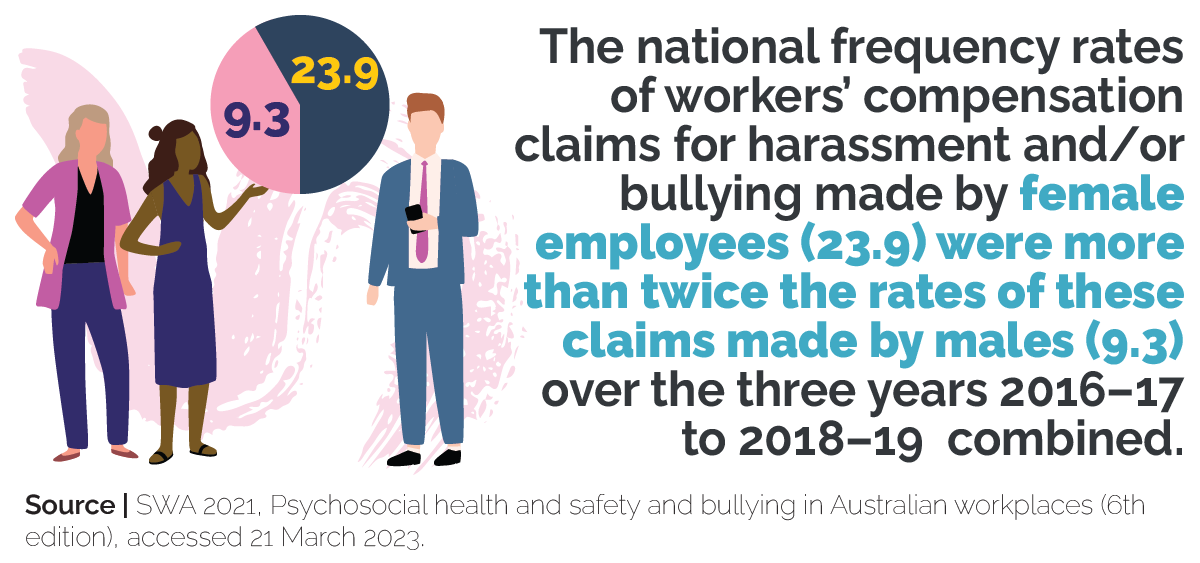
The frequency rates[1] of workers’ compensation claims for harassment and/or bullying made by female employees (23.9) were more than twice the rates of these claims made by males (9.3) over the three years 2016–17 to 2018–19p[2] combined.
Industry groups with the highest frequency rates of work-related harassment and/or workplace bullying, 2016–17 to 2018–19p combined, were Public safety services with 69.9, Residential care services with 68.5 and Civic, professional, and other interest group services with 66.6.
 Occupations with a higher risk of exposure to work-related harassment and/or workplace bullying include Miscellaneous clerical and administrative workers; Defence force members, fire fighters and police; and Miscellaneous labourers (SWA 2021).
ACT DATA
WorkSafe ACT’s psychosocial team undertook 671 workplace visits in the 2021-22 financial year and 126 workplace visits were conducted between July 2022 and February 2023.
Between 2017-18 and 2020-21, a total of 298 work-related harassment and/or workplace bullying workers’ compensation claims were accepted from the private sector and public sector combined. Women (66%) were almost as twice as likely as men (34%) to make a serious work-related harassment and/or workplace bullying.
Between 2017-18 and 2020-21, the industry with the largest number of accepted workers' compensation claims for work-related harassment and/or workplace bullying was Health care and social assistance, accounting for 48% of total claims, followed by Administrative and support services with 20% and Other services with 8%.

At the level of occupation, work-related harassment and/or workplace bullying claims were concentrated amongst Professionals with 27%, Community and personal service workers with 18% and Clerical and administrative workers with 18%.
WORKSAFE ACT’S RESPONSE
Over the past two years, WorkSafe ACT inspectors have conducted workplace visits or provided advice in response to several complaints or notifiable incidents related to workplace bullying.
WorkSafe ACT’s Psychosocial Team has integrated questions about workplace bullying into the checklist used by the team when inspecting worksites.
During this period, WorkSafe ACT has issued 28 improvement notices against s19 of the WHS act for failures to manage risks associated with bullying. Out of these 28 notices, 26 of them were generated due to complaints and two (2) from proactive campaigns.

WorkSafe ACT has also published a guide to managing the risk of workplace bullying on its website.
RESOURCES FOR PCBU’S AND WORKERS
WorkSafe ACT, Work-related bullying
WorkSafe ACT, Bullying - Know who to contact
WorkSafe ACT, Assistance From WorkSafe ACT
Safe Work Australia, Guide for preventing and responding to workplace bullying
Safe Work Australia, Model Code of Practice: Managing psychosocial hazards at work
WHS Code of Practice 2012, Code of Practice: Work Health and Safety (Preventing and Responding to Bullying) Code of Practice 2012 (No 1).
REFERENCES
ACT claims data provided by Workplace Safety and Industrial Relations Division, Chief Minister, Treasury and Economic Development Directorate (private sector and ACPTS claims only).
WHS Code of Practice 2012, Work Health and Safety (Preventing and Responding to Bullying) Code of Practice 2012 (No 1), accessed 21 March 2023.
SWA 2015, Work-related Mental Disorders Profile, accessed 21 March 2023.
SWA 2016a, Guide for preventing and responding to workplace bullying, accessed 21 March 2023.
SWA 2016b,Bullying & Harassment in Australian Workplaces: Results from the Australian Workplace Barometer Project 2014/15, accessed 21 March 2023.
SWA 2021, Psychosocial health and safety and bullying in Australian workplaces (6th edition), accessed 21 March 2023.
On this page