

Data snapshot - Young workers (2022)
Download the infographic version here:
Background
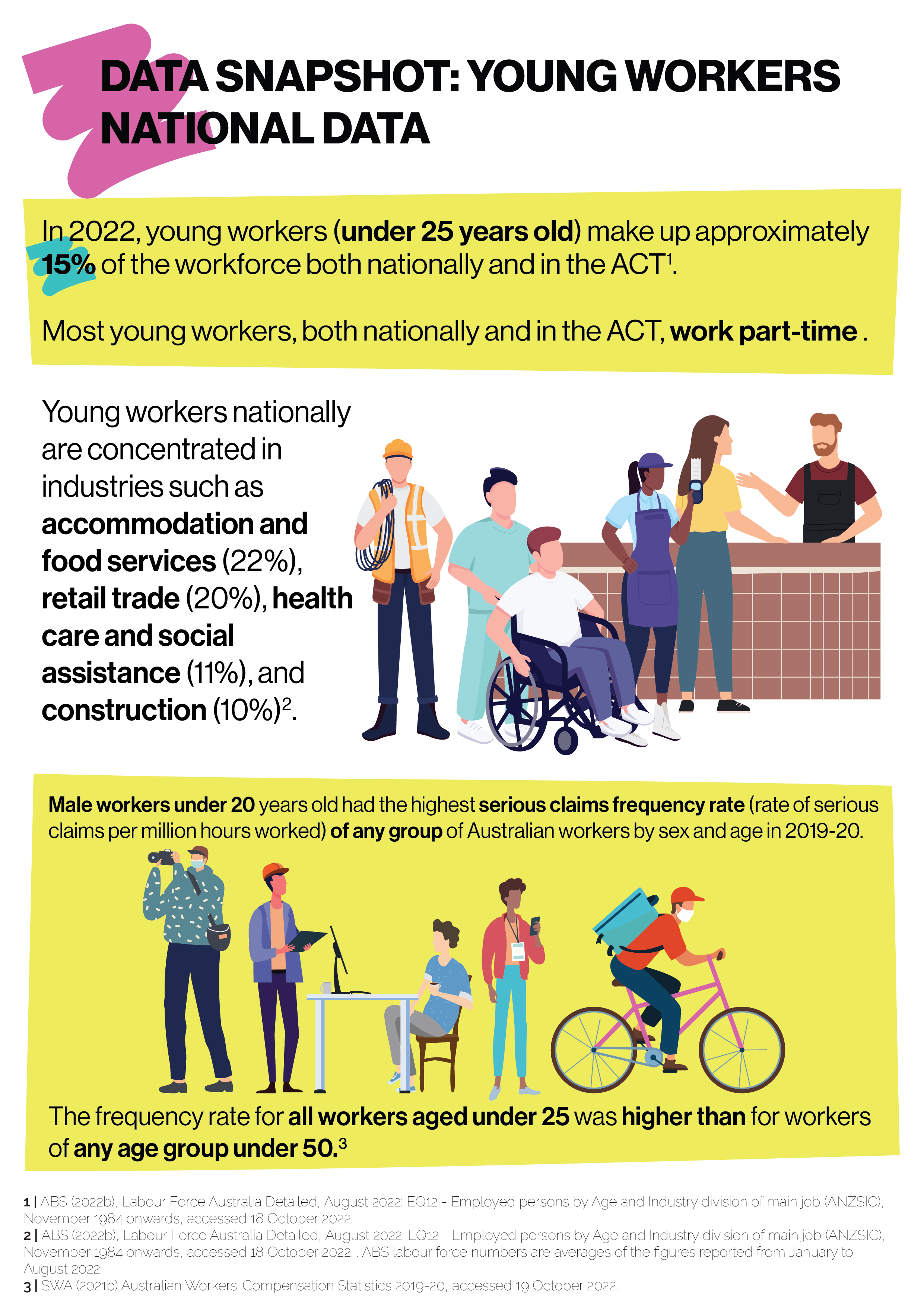
In 2022, young workers (workers under 25 years old) make up approximately 15% of the workforce nationally and in the ACT[1] (ABS 2022a).
Most young workers, both nationally and in the ACT, work part time (ABS 2022a).
Young workers nationally are concentrated in industries such as accommodation and food services (22%), retail trade (20%), health care and social assistance (11%), and construction (10%). By comparison, only 7% percent of all workers in Australia work in accommodation and food services and 10% in retail trade (ABS 2022b).

The most common occupations[2] of young workers nationally are:
- sales assistants and salespersons (16%)
- hospitality workers (9%)
- food preparation assistants (6%)
- carers and aides (5%) (ABS 2022c)
National data – deaths and workers’ compensation
Between 2016 and 2020 young workers accounted for 8% (74) of total worker deaths and 13% (20) of all construction deaths during this five-year period (SWA 2021a).
In 2019-20, young workers accounted for 13% of serious claims (accepted workers’ compensation claims resulting in an absence from work of more than one week) (SWA 2021b).
In 2019-20, the frequency rate (rate of serious claims per million hours worked) for all workers aged under 25 was higher than for workers of any age group under 50. Male workers under 20 years old had the highest serious claims frequency rate of any group of Australian workers by sex and age.[3][4]
Frequency rates for serious claims by young workers have been declining over time, falling by 35% from 2000-01 to 2018-19 (SWA 2021b).

ACT data
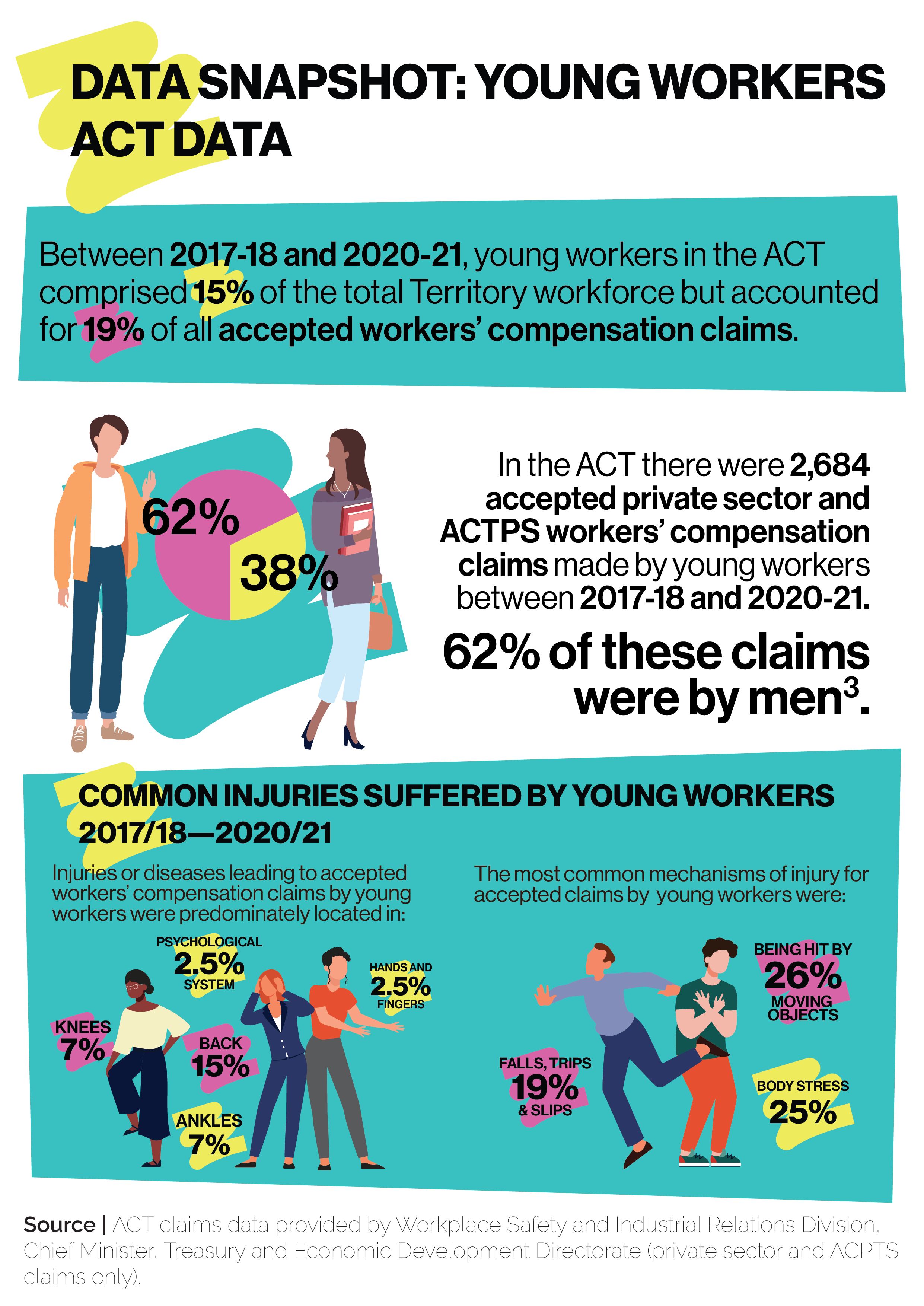
Between 2017-18 and 2020-21, young workers in the ACT comprised 15% of the total Territory workforce but accounted for 19% of all accepted workers’ compensation claims.
Of these 2684 accepted claims by young workers, males accounted for 62% and females for 38% compared to 57% and 43% for all accepted claims in the ACT during this time-period.
Accepted claims by young workers in the ACT were concentrated in industries like construction (27%), accommodation and food services (16%), and retail trade (13%).

Within the construction industry, more than half of all claims made by young workers were in construction services. Within the accommodation and food services industry more than two thirds of claims made by young workers were in food and beverage services.
The occupations with the highest number of accepted claims by young workers were other labourers,[5] construction trades workers, carers and aides, and hospitality workers. These four occupations together accounted for 44% of accepted claims by young workers in the ACT.
For young workers, the most common injures or diseases leading to an accepted claim were musculoskeletal disorders (49%) and wounds, lacerations, amputations and internal organ damage (31%).
However, compared to all ACT workers with accepted workers’ compensation claims, young workers were more likely to have an accepted claim for wounds, lacerations, amputations and internal organ damage and less likely to have a claim for musculoskeletal disorders or any kind of disease, including psychological diseases.
The most common mechanisms of injury for accepted claims by young workers were being hit by moving objects (26%), by body stressing (25%), and falls, trips, and slips (19%).
Injuries or diseases leading to accepted workers’ compensation claims by young workers were predominately located in the hand and fingers (26%), back (15%), knee (7%), and ankle (7%). Injuries and diseases located in the psychological system comprised 2.5% of all accepted claims.

WorkSafe ACT’s response
In November 2021 WorkSafe launched its Young Workers Strategy 2021-23 (the Strategy). The Strategy is focused on protecting young workers in ACT workplaces by:
- Increasing young workers’ awareness of WHS and workers’ compensation obligations.
- Supporting and enforcing WHS and workers’ compensation legislation compliance.
To support the development of the Strategy, WorkSafe ACT hired a young workers liaison officer and a young workers inspector, who together comprise the Young Workers Strategy Team. The Young Workers Strategy Team has conducted a range of activities to educate young people on their WHS rights and responsibilities, including presentations to apprentices and attending carers expos.
Between May and June 2022, together with Skills ACT, the Young Workers Strategy Team has enforced six breaches of s39 of the WHS Regulations 2011 for failures concerning the training and supervision of apprentices.
The Team has worked on the development of materials to support the Young Workers Strategy, including expanding the materials relating to young workers on the WorkSafe ACT website and the creation of a Young Workers Strategy Implementation Plan, Young Workers Strategy Communication Plan, and a branding suite.
Footnotes
[1] ABS labour force numbers are averages of the figures reported from January to August 2022 (the most recent month available).
[2] The occupations are ANZSCO (ABS 2021a) sub-major groups.
[3] The frequency rate for females under 20 in 2019-20 was roughly half that of male workers under 20 – 4.5 serious claims per million hours worked compared to 8.1 serious claims per million hours worked (SWA 2022b).
[4] Males under 20 consistently have high serious claims frequency rates; they had the third highest serious claims frequency rate of any group of Australian workers by sex and age in 2018-19 (SWA 2020a) and the highest serious claims frequency rate in 2017-18 (SWA 2020b).
Resources for PCBUs and workers
WorkSafe ACT, Young Workers Strategy 2021-23
WorkSafe ACT, Guidance Note – Supervision of Apprentices
WorkSafe NSW, Young Workers eToolkit
WorkSafe QLD, Young Workers
Fair Work Ombudsman, Young workers and students
References
ABS (Australian Bureau of Statistics) (2022a), Labour Force Australia Detailed August 2022: LM1 - Labour force status by Age, Greater Capital City and Rest of State (ASGS), Marital status and Sex, February 1978 onwards, accessed 18 October 2022.
ABS (2022b), Labour Force Australia Detailed, August 2022: EQ12 - Employed persons by Age and Industry division of main job (ANZSIC), November 1984 onwards, accessed 18 October 2022.
ABS (2022c), Labour Force Australia Detailed, August 2022: EQ07a - Employed persons by Age, Occupation sub-major group of main job (ANZSCO) and Sex, August 1986 onwards, accessed 18 October 2022.
ABS (2021a) ANZSCO - Australian and New Zealand Standard Classification of Occupations, 2021, accessed 20 April 2022.
SWA (Safe Work Australia) (2021a), Work-Related Traumatic Injury Fatalities Australia 2020, accessed 19 October 2022.
SWA (2021b) Australian Workers’ Compensation Statistics 2019-20, accessed 19 October2022.
SWA (2020a) Australian Workers’ Compensation Statistics 2018-19, accessed 19 October2022.
SWA (2022b) Australian Workers’ Compensation Statistics 2017-18, accessed 19 October2022.
SWA (2008) Type of occurrence classification system (TOOCS) 3rd Edition May 2008, accessed 19 April 2022.
On this page